Motion handoff template for Credits tribe
A standardized motion handoff template used by the entire Credits tribe, ensuring every interaction spec is delivered consistently to engineers.
Context
Motion became a core part of Mercado Libre's credit products, but each designer documented it their own way — so specs died in translation and engineers rebuilt micro-interactions by eye. The Credits tribe needed one shared language for handing off motion.
The problem
Different designers were documenting motion in different ways, causing inconsistent implementations and extra back-and-forth with engineers across the tribe.
Process & decisions
Auditing where motion got lost
I reviewed how motion specs traveled from design to code across the tribe: scattered videos, loose prose, no timing source of truth. Engineers had no way to know what triggered an animation, in what order layers moved, or with which curves.
One template, engineer-first
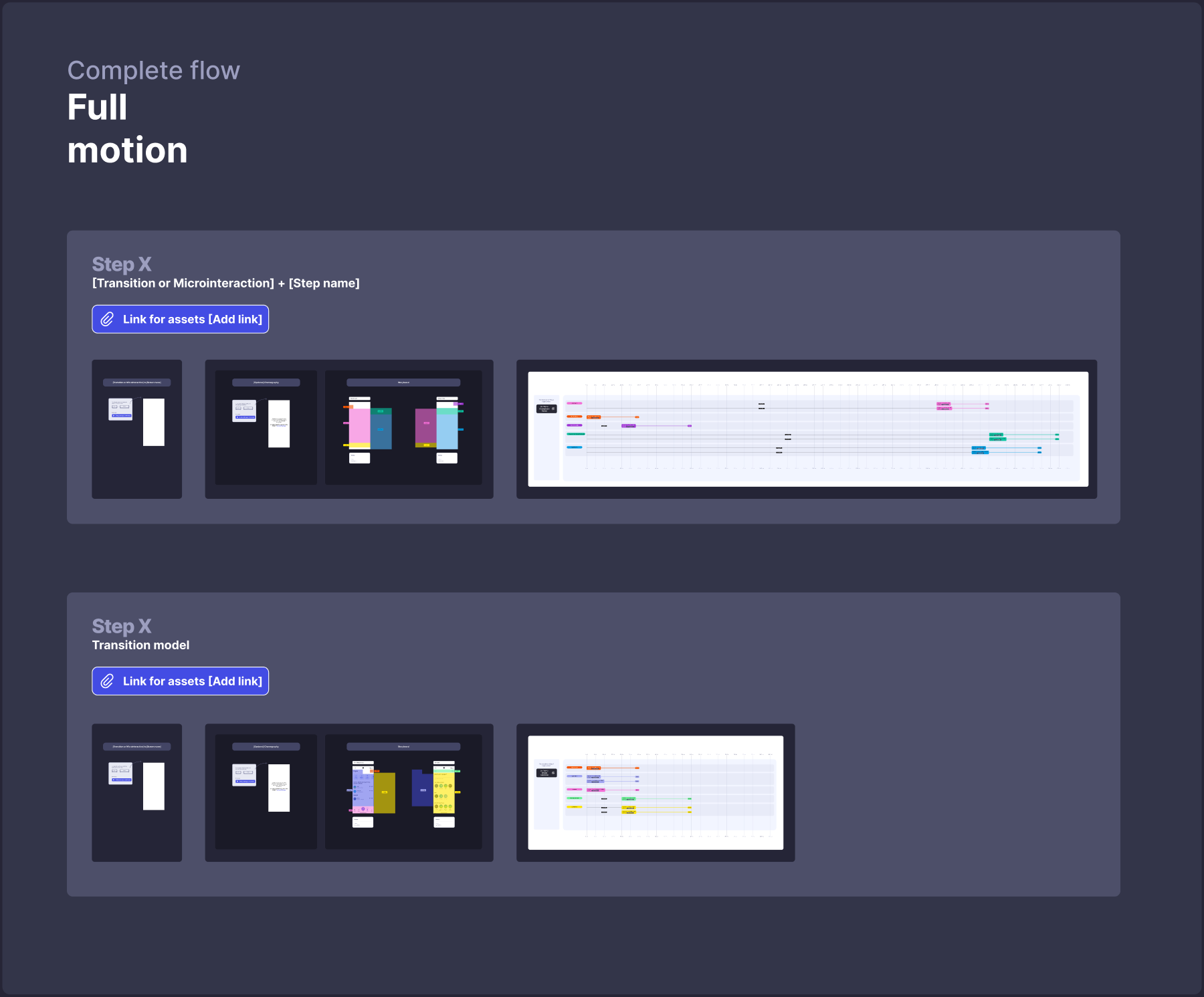
I structured the handoff step by step: each transition or micro-interaction ships with its prototype video, choreography notes, a color-coded storyboard of the affected layers, and an After Effects-style timeline mapping every layer's duration and easing — all anchored to an explicit trigger, like "on tap in component".

Rolling it out as the tribe standard
The template was adopted as the default motion handoff format across the Credits tribe, turning motion from a designer-by-designer habit into a repeatable part of the delivery pipeline.
The solution
I defined a single motion handoff template with fields for trigger, duration, easing, layer order, and examples. The template was rolled out as the tribe standard.
Results
- Tribe-wide standard
- Faster implementation
- Consistent motion language
The template became the reference for motion delivery in the Credits tribe, reducing ambiguity and saving time on every handoff.
Screens

Dealertool — B2B vehicle financing